
How to Get More Patients for Your Clinic Using Google
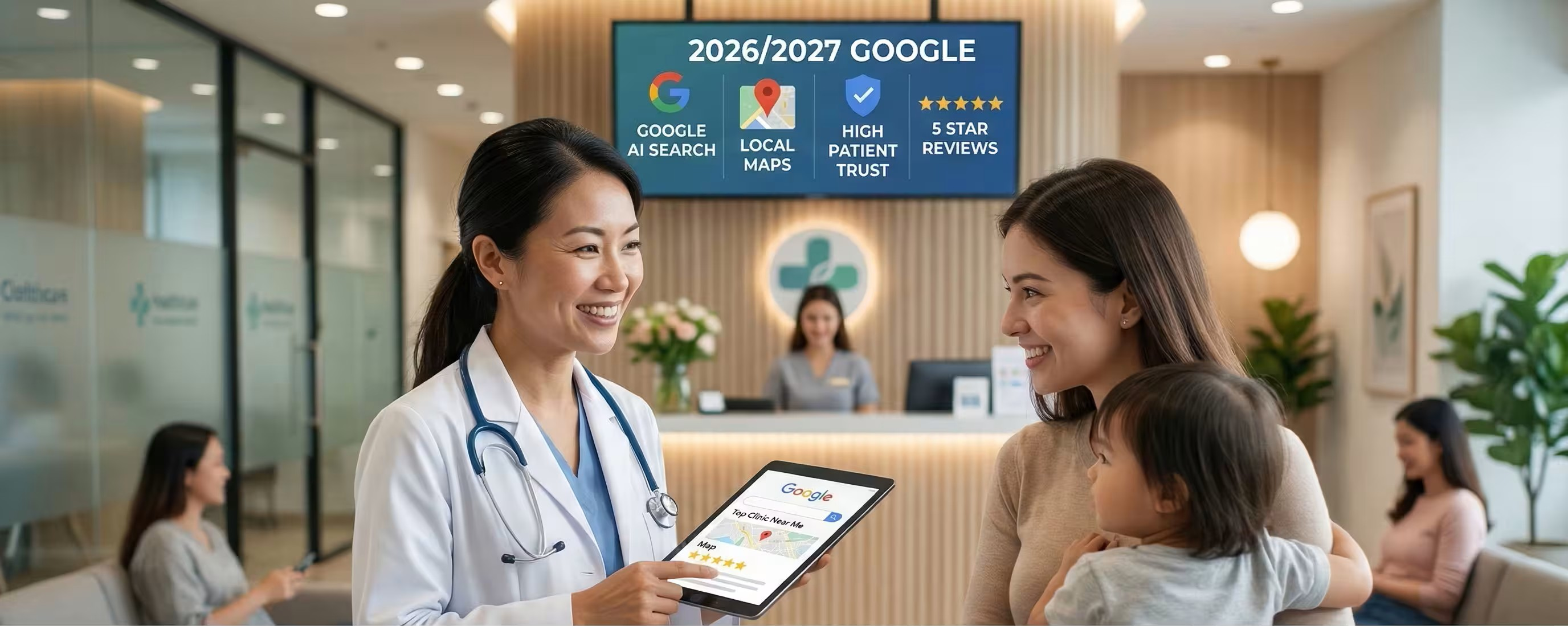
The "digital front door" of a medical clinic has undergone a tectonic shift. In 2024, a patient might have searched for a "dentist near me" and clicked the first blue link. By 2026 and 2027, the journey is vastly different. Today, patients engage with AI-powered discovery—Google’s AI Overviews (SGE), voice-activated assistants, and Large Language Models (LLMs) like Gemini and Chat GPT—to diagnose symptoms and choose providers without ever visiting a website.
If your clinic isn't appearing in these AI-generated summaries or dominating the "Zero-Click" landscape, you are effectively invisible to 70% of new patients. This guide provides a deep dive into the strategies required to thrive in this new era of healthcare marketing.
1. The New Era: From SEO to GEO (Generative Engine Optimization)
Traditional Search Engine Optimization (SEO) focused on ranking for keywords. In 2027, we practice Generative Engine Optimization (GEO). This is the science of making your clinic’s data "citable" by AI models.
Why GEO Matters
When a patient asks an AI, "Which clinic in Seattle has the shortest wait times for an MRI?", the AI doesn't just show a website; it synthesizes an answer from multiple data points. To be the clinic that the AI recommends, your content must be structured for machine readability.
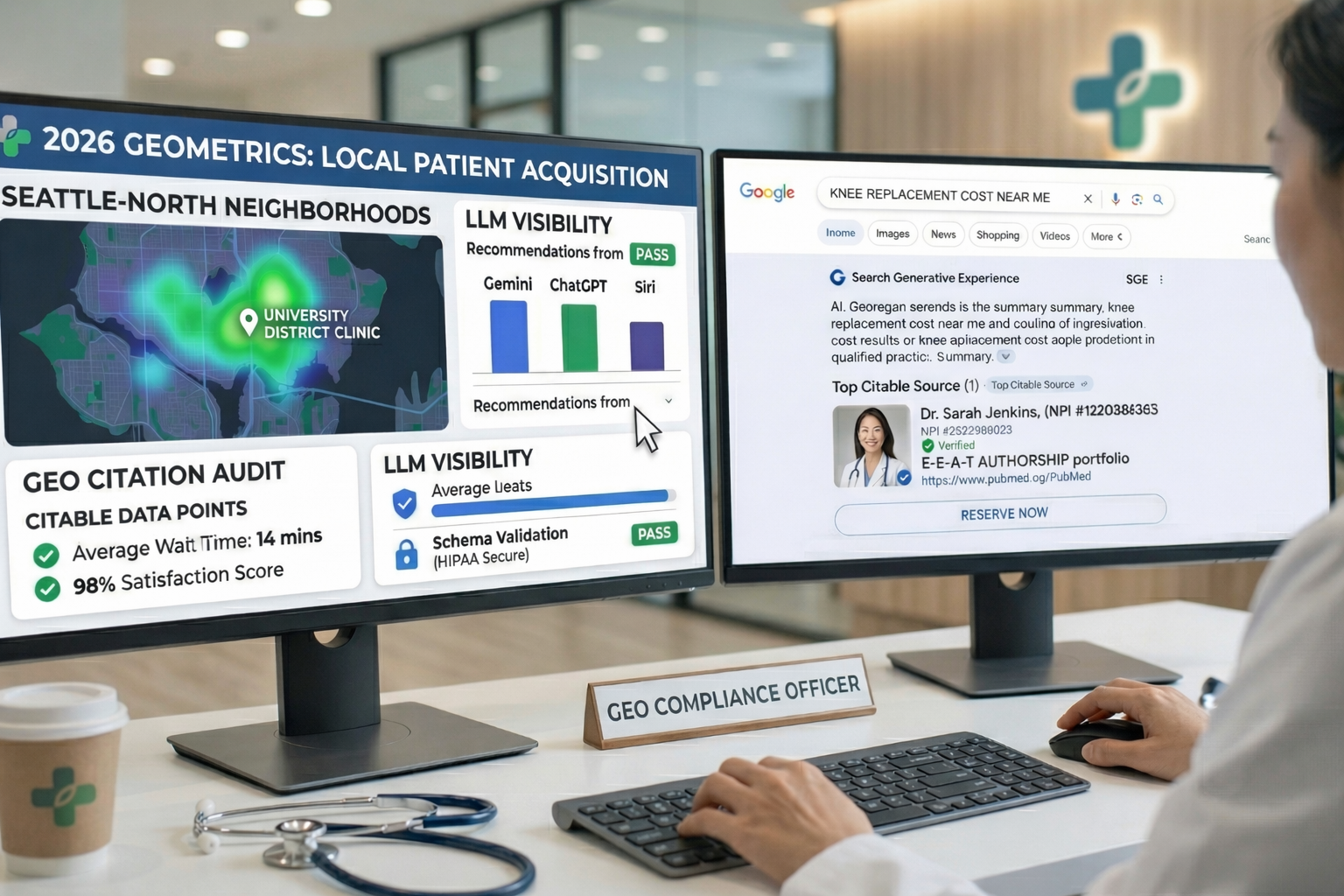
Statistical Integration: Research shows that AI models prioritize content containing hard data. Instead of saying "We have short wait times," use: "Our average wait time for new patient consultations in 2026 was 14 minutes."
Structured Data (Schema Markup): Use
Medical BusinessandPhysicianschema. This is hidden code that tells Google’s AI exactly what your NPI number is, which insurance you accept, and your real-time availability.
2. Dominating the "Zero-Click" Experience
By 2026, over 65% of medical searches are "Zero-Click." This means the patient gets all the information they need (phone number, reviews, and booking) directly on the Google search results page.
Google Business Profile (GBP) Optimization
Your GBP is now more important than your homepage. To dominate the Local Pack in 2027:
Real-Time Booking: Integration with platforms like Zocdoc or NexHealth is mandatory. If a patient can’t book a slot directly from Google Maps in two clicks, they will move to a competitor who allows it.
Insurance Filtering: Google now allows patients to filter search results by the insurance they carry. Ensure every single plan you accept is listed in your profile.
The "Vibe" Check with Video: Static photos are baseline. High-ranking profiles in 2027 feature "Clinic Shorts"—30-second vertical videos where doctors explain a procedure or walk through the office. This reduces "white coat hypertension" and builds immediate trust.
3. The E-E-A-T Framework: The Gold Standard of Medical Trust
Google treats medical content as YMYL (Your Money or Your Life). In 2026, the algorithm has become incredibly sophisticated at detecting "AI-generated slop" versus genuine medical expertise.
Establishing Expertise and Experience
Physician-Authored Content: Every blog post must have a "Medically Reviewed By" byline. Google’s "Knowledge Graph" tracks individual doctors. If Dr. Sarah Jenkins is a board-certified dermatologist with a LinkedIn profile and published research, her articles will rank higher than a ghostwritten post.
Authoritative Citations: Don't just give advice; ground it in science. Use LaTeX for clinical formulas where relevant to signal technical depth:
We use the Basal Metabolic Rate (BMR) to tailor your weight loss program:
P = (10 * m) + (6.25 * h) - (5 * a) + s
where m is mass in kg, h is height in cm, a is age in years, and s is a constant for gender.
First-Hand Proof: Include original, non-stock photography of your medical equipment, your staff in action, and your facility. Google’s Vision AI can detect stock photos and will lower the "Experience" score of sites that use them excessively.
4. Hyper-Local SEO: Winning the Neighborhood
Most patients travel less than 15 minutes for non-emergency care. Your strategy must be hyper-local.
Neighborhood-Specific Landing Pages
Instead of one "Contact Us" page, create pages for every neighborhood you serve.
Example: "Pediatric Urgent Care for Families in [Neighborhood Name]."
Local Justification: Mention nearby landmarks or local schools. This tells Google’s AI that you are physically and socially embedded in that specific community.
The Review Velocity Strategy
In 2027, it’s not just about the number of stars; it’s about Review Velocity (how often you get new ones) and Sentiment Depth.
Automated SMS: Use a system that texts a review link exactly 2 hours after the patient checks out.
Semantic Keywords in Reviews: Google reads reviews to "justify" rankings. A review saying, "Best clinic for pediatric asthma in Austin," is worth ten reviews that just say "Great doctor."
5. Content Strategy: The "Patient Intent" Model
To reach the 2,000-word authority threshold on your website, you must address the three stages of the patient journey.
Stage 1: The Informational Query (The "Why")
Patients search for symptoms.
Topic Idea: "Why is my child coughing only at night?"
Goal: Provide value without a hard sell. Use clear, empathetic language. In 2026, "Clarity beats Cleverness."
Stage 2: The Navigational Query (The "Who")
Patients search for types of doctors.
Topic Idea: "Dermatologist vs. Esthetician for Acne."
Goal: Use comparison tables. Patients in 2027 are data-driven.
Feature | Private Clinic | Large Hospital |
Wait Time | < 15 Mins | 2+ Hours |
Doctor Access | Same-day | 3-week lead time |
Personalization | High | Low |
Stage 3: The Transactional Query (The "Where")
Patients are ready to book.
Topic Idea: "Best knee surgeon in [City] with 5-star reviews."
Goal: Remove all friction. Your "Book Now" button should be floating and omnipresent on mobile.
6. Technical Performance: The "Instant" Requirement
By 2027, Google’s Interaction to Next Paint (INP) metric is the king of technical SEO. If a patient clicks a button on your site and it doesn't respond within 200 milliseconds, Google will de-rank you.
Mobile-First Design: 85% of healthcare searches happen on smartphones.
Accessibility (ADA Compliance): Ensure your site is usable by patients with visual or motor impairments. This isn't just a legal requirement; it’s a ranking signal for "Trust."
7. The Role of Short-Form Video (Shorts & Reels)
Google Search results in 2027 are "Multimodal." This means a YouTube Short or a TikTok clip can rank #1 for a medical question.
The 60-Second Rule: Every week, have your lead physician film three 60-second clips answering common patient questions.
Transcription is Key: AI cannot always "hear" your video perfectly. Always upload a high-accuracy transcript so Google can index the medical keywords spoken in the video.
8. Ethics, Privacy, and HIPAA in 2027
As AI grows, so do patient concerns about privacy.
Zero-Party Data: Be transparent about how you use data. Explicitly state on your booking forms: "Your medical data is encrypted and never sold to third-party advertisers."
The Human-in-the-Loop: While you can use AI chatbots to handle basic scheduling, always provide an "Escape to Human" button. Research shows that 74% of patients still want the option to speak to a real person for complex medical concerns.
Conclusion: The Roadmap to 2027
Winning on Google is no longer about "gaming the system." It is about demonstrable authority. To get more patients:
Structure your data so AI models can cite you.
Optimize your Google Business Profile for the Zero-Click user.
Produce high-E-E-A-T content that proves your physicians are real, qualified experts.
Leverage video to build a human connection before the first appointment.
The clinics that thrive in 2027 will be those that treat their digital presence not as an advertisement, but as an extension of their clinical care.
External Resources & High-Authority References
To provide your clinic with the most scientifically grounded and data-backed strategy for 2026 and 2027, we have curated a list of external resources. These links connect you to the latest research in healthcare AI, digital patient behavior, and Google’s own technical requirements for medical providers.
2026 US Health Care Executive Outlook (Deloitte Insights)
Focus: Understanding the macro-shift toward "Digital-First" patient experiences and how health equity is being integrated into search results.
Trends in 2026 for Healthcare: AI-Driven Patient Care (Capgemini)
Focus: Deep dive into how Generative AI is moving from back-office tasks to the primary interface for patient discovery and triage.
Digital Marketing Strategy for Healthcare: The 2026 Guide (Exposure Ninja)
Focus: Practical benchmarks for clinic SEO, including the "1 in 6 adults" statistic regarding AI health platform usage.
Google Business Profile Guide for Doctors (rater8)
Focus: Technical best practices for managing multiple provider listings and ensuring high review velocity without violating HIPAA.
Consumer Insights & Digital Marketing Predictions 2026 (Think with Google)
Focus: Direct data from Google regarding how user intent is shifting from "search" to "assistance" via Gemini and SGE.
Written by
BIKASH HALDER
I engineer growth systems that turn traffic into revenue for ambitious founders and agencies. Let's discuss your next project and how we can elevate your web presence.
Book a Strategy Call